Cashless Payments in Southeast Asia: What Works in Thailand
A practical guide to QR payments, wallets and cross-border services, with the checks that matter before relying on a phone to pay.

Editors
Jun 2, 2026 · 6 min read
Status
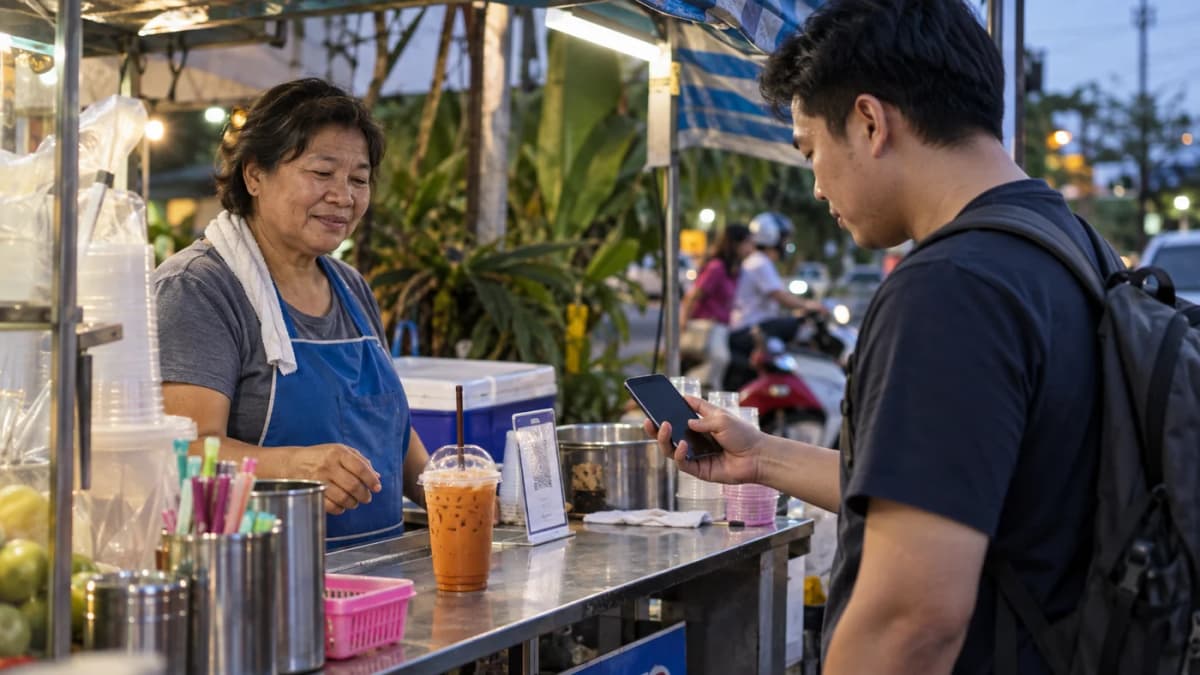
A QR code beside an iced-coffee stall looks simple. Whether you can actually pay with it depends on something less obvious: which app you have, where your account is registered and whether that particular payment route is supported.
That is the useful way to understand Southeast Asia's cashless shift. More services are connecting, but the region is not one borderless wallet. A payment that works in Thailand may fail after a flight to another country, even when the signs look familiar.
This guide focuses on everyday payments and cross-border checks, not predictions about fintech investments. Official service information was checked on 4 October 2026; check your provider again before travelling.
Three different things often get called a digital payment
A bank account holds your money with a bank. A wallet is a separate product with its own identity checks, balance rules and supported services. A payment system connects transactions. Having access to one does not automatically give you access to the others.
A super-app may put shopping, transport and payment features in the same place. That convenience does not mean every feature is available to every user in every country. An account created for ordering rides is not proof that you qualify for its financial products.
For a newcomer in Thailand, start with the job you need done: paying for lunch, receiving a salary, sending money home or collecting customer payments. Those are different questions.
Thai QR payments are useful, but a camera is not a payment app
Opening your phone camera and recognising a QR code does not make a payment possible. You need a financial app that supports the transaction and an eligible, funded account or wallet behind it.
If you live here, ask your bank which QR payment functions it provides and how to activate them. Registration for receiving money through a mobile-number alias and the ability to scan a merchant code are not the same setup question. Have staff show you the relevant function rather than following an old screenshot tutorial.
Opening a local account is a separate process. Our Thai bank-account preparation guide explains what to ask before visiting a branch. A Thai SIM or a long hotel booking does not itself establish banking eligibility.
Can a visitor pay using an app from home?
Sometimes. The Thai government's July 2026 Pay Like a Local announcement describes home-country banking apps and wallets working at participating Thai businesses. The important word is participating. This is not a promise that every foreign bank app can scan every Thai code.
The Bank of Thailand's cross-border payment guide separates QR purchases from mobile-number money transfers and lists participating routes. Its examples include Malaysian visitors paying Thai merchants through a supported app, and Singapore-Thailand transfers addressed to a recipient's phone number.
Those are different services. A successful transfer to someone abroad does not prove you can use that app at a shop there. Nor does a country's inclusion in a network establish support for your particular bank.
- Check the destination country, your issuing bank or wallet and the merchant network together.
- Complete any required identity verification before leaving home.
- Check transaction limits, fees and the exchange quote inside your own provider's service.
- Try a small ordinary purchase while you still have a usable backup.
What changes when you leave Thailand?
Do not assume a wallet travels as easily as your suitcase. Indonesia uses QRIS; Malaysia uses DuitNow QR. The symbols identify local payment arrangements, not a guarantee that all foreign apps work.
Bank Indonesia's QRIS guide explains cross-border use through participating payment apps and partner countries, including Thailand, Malaysia and Singapore. It also provides provider details. Check those details rather than treating a regional connectivity headline as your personal payment instructions.
Keep your home app available and working before a trip. Downloading another country's wallet after landing may leave you facing identity requirements you cannot meet. Avoid building your first evening around an untested signup.
Compare the amount you actually pay
A low transfer fee is only part of the cost. Currency conversion, card or wallet charges and the amount the recipient receives also matter. Compare equivalent transactions at roughly the same time, not a bank transfer quote with a card purchase in another currency.
Before confirming, read the merchant amount, your debit amount and any displayed fee. For larger expenses, use our baht exchange-rate and fee comparison guide to organise the quotes. No payment route is automatically cheapest for everyone.
For a card purchase or ATM withdrawal, inspect any offered currency conversion before accepting it. Your card issuer's own charges still matter. Keep the receipt if the final amount differs from what you expected.
A safe payment takes a few extra seconds
Check the recipient name and amount before approving a QR payment. If the name is unfamiliar, ask the seller to explain it. A legitimate shop may use a proprietor's name, but you should understand who is receiving the money.
After paying, wait for the merchant to confirm receipt. A picture of a payment slip is not the same thing as the seller seeing money arrive. If the transaction appears pending, check its history before sending another one and risking a duplicate.
Do not install a payment app from a message, hand over a one-time code or allow a stranger to operate your phone. If money goes to the wrong recipient or something looks fraudulent, contact the payment provider promptly through its official channel and keep the transaction reference.
Keep a fallback that does not depend on the same phone
Carry enough cash for small purchases and an unexpected journey, plus a usable card where appropriate. A second wallet on the same dead phone is not much of a backup.
Check connectivity, roaming and access to verification messages. Our Thai mobile-operator guide can help with the connection side. Keep the phone charged and avoid depending entirely on a restaurant's Wi-Fi.
Cash is especially useful when plans take you away from bigger shopping areas. If you are organising day trips from Hua Hin, confirm payment arrangements for transport and stops before setting out.
For businesses, receiving money is only the beginning
A seller needs to reconcile each payment with an order, understand settlement timing and handle refunds. Personal transfer access does not automatically make a suitable business collection service.
Our Thailand online-selling guide covers that operational side. Ask your provider about the right merchant product and charges instead of assuming a personal QR arrangement is sufficient.
Frequently asked questions
Can every foreign banking app scan Thai QR codes?
No. Cross-border access depends on the participating provider, payment route and merchant. Check your app's current Thailand support and carry a backup payment method.
Are cross-border QR purchases the same as international transfers?
No. Paying a participating merchant and sending money to a recipient abroad are different services. Support for one does not establish support for the other.
Should I travel around Thailand without cash?
It is safer to keep a modest cash backup alongside your supported digital payment method. Phone battery, connectivity, service availability and merchant acceptance can all affect a purchase.
Ananas Premium
Unlock Hua Hin's Best Property & Investment Insights
Enjoying our free content? Get unlimited access to premium articles, local market intelligence, member briefings, and exclusive checklists for ฿290 / $9.95 per month.
Sources & Verification
- Participating cross-border QR purchases and mobile-number remittances are distinct services; May 2026 provider information and examples, no universal connectivity or fee claim. — Bank of Thailand — Cross-Border PaymentSource
- 8 July 2026 announcement about supported home-country apps at participating Thai businesses, not every foreign app or merchant. — Thai Public Relations Department — Pay Like a LocalSource
- QRIS cross-border participating apps and partner countries, confirmation of recipient and transaction; no regional adoption or payment-volume statistics. — Bank Indonesia — QRISSource